Posture Correction for Desk Workers in Dublin — Fix the Root Cause of Your Pain
Dublin has cemented its place as one of Europe's leading technology hubs. The European headquarters of Google, Meta, Salesforce, HubSpot, and Stripe all sit within a few kilometres of each other, and thousands of smaller tech companies, financial services firms, and creative agencies fill the Docklands, the IFSC, and business parks stretching out towards Sandyford and Citywest. For the people who work in these offices, the daily reality is remarkably similar regardless of the company name on the door: eight, nine, sometimes ten or more hours a day spent seated at a desk, staring at a screen.
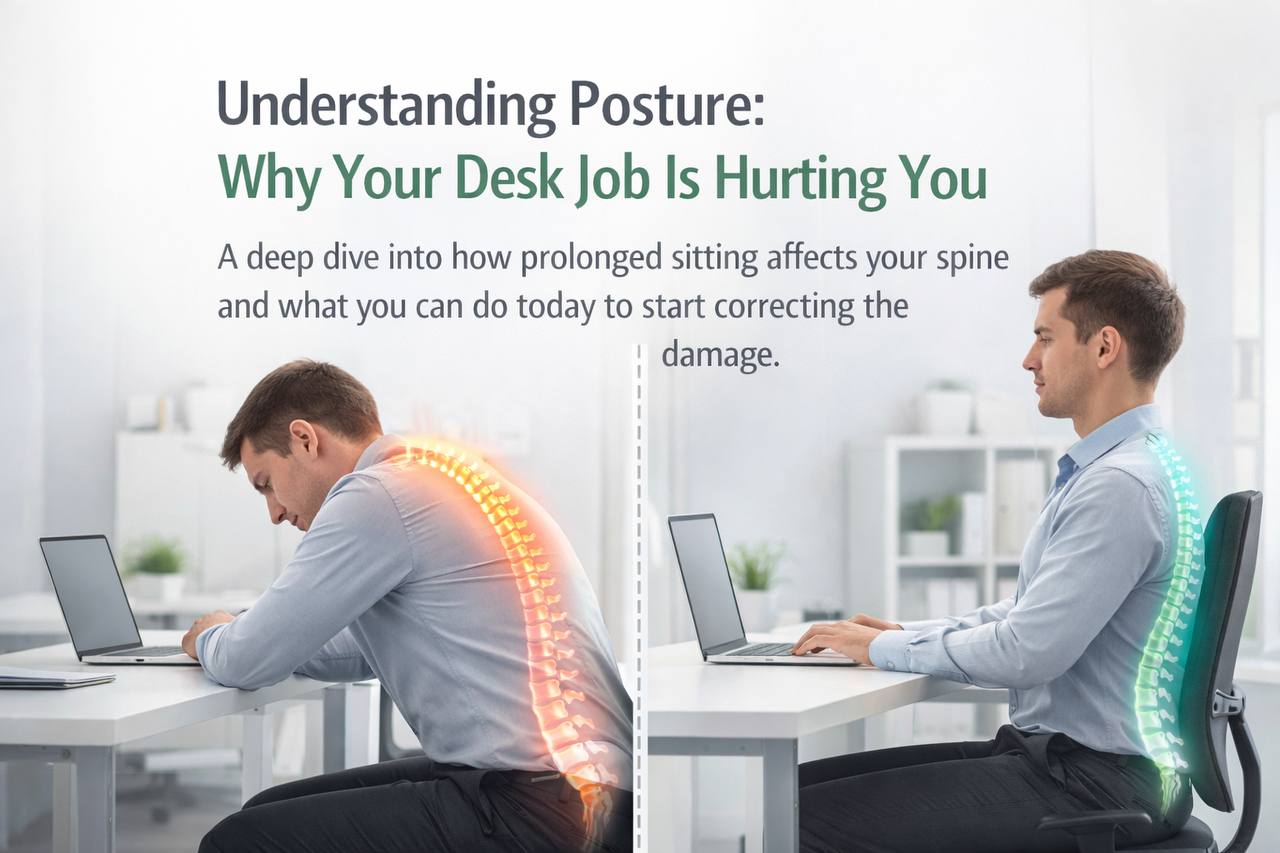
That level of sustained sitting is doing measurable damage to your body. After years of desk work, the muscles that hold you upright weaken, the tissues across the front of your body shorten, and your spine gradually drifts out of its optimal alignment. The result is chronic pain — in your neck, your upper back, your lower back, your shoulders, and often your head. If you have ever stood up after a long day at work and felt stiff, achy, and ten years older than you actually are, you are already experiencing the consequences of postural dysfunction.
At MoveWell, we see this pattern every day. Our clinic works with desk-based professionals across Dublin who are tired of living with pain that paracetamol and the occasional stretch cannot resolve. We use a structured, evidence-based approach to identify precisely which postural imbalances are driving your symptoms, then treat the cause rather than masking the effects. The good news is that poor posture is not permanent. With the right intervention, your body can change.
The "Tech Neck" Epidemic in Dublin's Offices
The term "tech neck" has entered common usage for good reason. When you sit at a desk and focus on a screen, your head drifts forward. The average human head weighs roughly five kilogrammes. For every inch it moves ahead of the centre line of your shoulders, the effective load on your cervical spine increases dramatically — at just two inches forward, your neck muscles are working as though your head weighs closer to fifteen kilogrammes. Multiply that strain across an eight-hour workday, five days a week, for several years, and the accumulated tissue damage is substantial.
Forward head posture is only the beginning. The shoulders round inward as the pectoral muscles shorten. The upper back develops an exaggerated kyphotic curve. The hip flexors tighten from hours of sitting, pulling the pelvis into an anterior tilt that compresses the lumbar spine. The deep stabilising muscles of the core and the lower trapezius muscles of the upper back gradually weaken from disuse. The body adapts to the position you spend the most time in, and for most Dublin professionals, that position is a slouched, forward-leaning posture locked in place by a desk, a chair, and a laptop screen that sits far too low.
Research consistently shows that between 60 and 80 per cent of office workers experience musculoskeletal pain at some point during their career. In Ireland specifically, back pain and neck pain remain among the most common reasons for GP visits and workplace absenteeism. This is not a minor inconvenience — it is a widespread occupational health issue that affects productivity, quality of life, and long-term wellbeing.
How Bad Posture Causes Pain
Understanding the connection between your posture and your symptoms is the first step towards fixing the problem. Poor alignment does not cause pain randomly — it creates predictable patterns of dysfunction that produce specific types of discomfort.
Upper Back and Neck Pain
When your head sits forward of your shoulders, the muscles at the back of your neck and the upper portion of your trapezius are forced to work constantly to prevent your head from dropping further forward. These muscles were not designed for sustained isometric contraction at that intensity. Over time they develop trigger points — hyperirritable knots within the muscle fibres that produce localised pain and referred discomfort. The suboccipital muscles at the base of your skull become particularly tight, compressing the greater occipital nerve and creating a band of tension that radiates from the back of the head to behind the eyes.
Lower Back Pain
Prolonged sitting shortens the hip flexors, particularly the psoas major, which attaches directly to the lumbar vertebrae. When this muscle becomes chronically tight, it pulls the lower spine into excessive extension, compressing the facet joints and loading the lumbar discs unevenly. The result is a dull, persistent ache across the lower back that worsens throughout the day and may become sharp when standing or walking after a long period of sitting. If you are experiencing persistent lower back pain, our back pain treatment guide offers a detailed overview of how we approach this at MoveWell.
Headaches and Migraines
Cervicogenic headaches — headaches originating from dysfunction in the cervical spine — are extremely common among desk workers. The tight suboccipital muscles, restricted upper cervical joints, and compressed occipital nerves that result from forward head posture are a reliable recipe for recurrent headaches. Many clients come to us believing they suffer from migraines or tension headaches when the true source is mechanical dysfunction in the neck. Addressing the postural cause often reduces or eliminates the headaches entirely. We cover this topic in depth in our headache and neck tension relief article.
Shoulder Pain and Restricted Movement
Rounded shoulders alter the mechanics of the shoulder joint. The scapulae drift forward and tilt anteriorly, narrowing the subacromial space where the rotator cuff tendons pass. This creates impingement — a pinching of the tendons during overhead movements that produces sharp pain in the front or side of the shoulder. Over time, this impingement can lead to tendinopathy or bursitis. Many shoulder problems that appear to be joint issues are actually driven by poor thoracic and scapular posture.
Jaw Tension (TMJ Connection)
The connection between posture and jaw pain surprises many people, but it is well documented. Forward head posture changes the resting position of the mandible and increases tension in the muscles of mastication. If you clench your jaw during concentrated work — and many desk workers do without realising it — the combination of postural strain and habitual clenching can produce temporomandibular joint dysfunction, presenting as jaw pain, clicking, difficulty opening the mouth fully, and even ear pain.
The MoveWell Posture Assessment
Effective posture correction begins with a thorough assessment. At MoveWell, we do not guess — we evaluate your posture systematically to identify exactly which structures are contributing to your pain.
Our assessment includes a visual posture analysis from anterior, posterior, and lateral perspectives. We look at the position of your head relative to your shoulders, the curvature of your thoracic and lumbar spine, the alignment of your pelvis, and the position of your feet. We then perform a movement screening to assess how your posture affects the way you move — examining overhead reach, spinal rotation, squat mechanics, and single-leg balance.
Muscle length and strength testing allows us to quantify specific imbalances. We measure the flexibility of your pectorals, hip flexors, hamstrings, and suboccipital muscles, and we test the activation and strength of your deep neck flexors, lower trapezius, serratus anterior, and gluteal muscles. This gives us a precise map of your dysfunction pattern — which muscles are overactive and shortened, and which are inhibited and weak.
Based on these findings, we create a corrective treatment plan tailored to your specific presentation. No two posture correction programmes at MoveWell are identical, because no two people have the same combination of imbalances.
How We Fix Your Posture
Posture correction requires a multi-layered approach. Stretching alone will not resolve the problem. Neither will simply buying a new chair. At MoveWell, we combine hands-on treatment with active rehabilitation and environmental modification to create lasting change.
Manual therapy forms the foundation of our approach. We use targeted soft tissue techniques to release the muscles that have shortened and tightened from prolonged sitting. The pectoralis major and minor are addressed to open the chest. The hip flexors — psoas, iliacus, and rectus femoris — are released to restore neutral pelvic alignment. The suboccipital muscles and upper trapezius are treated to reduce cervical compression and relieve headache-generating tension. Deep tissue massage, myofascial release, and trigger point therapy are applied based on what your tissues need.
Strengthening weak muscles is equally critical. Releasing tight muscles provides immediate relief, but without strengthening the opposing muscle groups, the imbalance will return. We prescribe specific exercises to activate your deep neck flexors, which counteract forward head posture. Lower trapezius and serratus anterior exercises restore proper scapular mechanics. Gluteal activation and core stability work corrects pelvic alignment and protects the lumbar spine. These exercises are simple, require minimal equipment, and are designed to fit into a busy schedule.
Myofascial release techniques address the fascial restrictions that develop when tissues are held in shortened positions for extended periods. Fascia adapts to habitual postures by laying down additional collagen along lines of stress, creating a structural reinforcement of poor alignment. Sustained myofascial release helps remodel these restrictions and restores tissue pliability.
Corrective exercise prescription gives you the tools to continue your progress between sessions. We provide clear, demonstrated exercise programmes that typically take ten to fifteen minutes per day. Each programme is progressive — as your posture improves, the exercises evolve to maintain challenge and drive further adaptation.
Ergonomic workstation advice ensures that you are not spending eight hours a day reinforcing the very patterns we are working to correct. We review your desk setup and make specific, practical recommendations that you can implement immediately.
Desk job destroying your posture? It's not too late to fix it.
Get assessed at MoveWell Dublin →Ergonomic Setup Guide — Fix Your Desk Today
Your workstation setup matters more than most people realise. Even with perfect muscular balance, spending eight hours in a poorly configured workspace will gradually pull your body out of alignment. Here is how to set up your desk properly — whether you work from a Google Docks office, a co-working space in the city centre, or a home office in Rathmines.
Monitor height and distance. The top of your screen should sit at or just below eye level. If you use a laptop, invest in a laptop stand or external monitor — working with a screen at desk height forces your head into a flexed, forward position that accelerates cervical dysfunction. Position the monitor at arm's length — roughly 50 to 70 centimetres from your eyes. If you use dual monitors, angle them in a gentle V shape and keep the primary screen directly ahead of you.
Chair setup. Adjust the seat height so that your feet rest flat on the floor with your knees bent at approximately 90 degrees. Your hips should be level with or slightly higher than your knees. Use the lumbar support built into your chair — if your chair lacks adequate lumbar support, a small rolled towel or dedicated lumbar cushion placed in the curve of your lower back can make a significant difference. Adjust the armrests so that your elbows rest at 90 degrees without your shoulders hiking upward. If the armrests push your shoulders up, lower them or remove them entirely.
Keyboard and mouse positioning. Your keyboard should sit close enough that your elbows remain by your sides while typing. Reaching forward to type causes the shoulders to protract and the upper back to round. Position your mouse immediately beside the keyboard on the same level. A split or ergonomic keyboard can reduce wrist strain, and a vertical mouse places the forearm in a more neutral rotational position.
Standing desk tips. If you have access to a sit-stand desk, alternate between sitting and standing every 30 to 45 minutes. When standing, keep your weight evenly distributed across both feet, avoid locking your knees, and ensure the monitor and keyboard heights are adjusted to match the standing position. Standing all day is not inherently better than sitting all day — the benefit comes from changing positions regularly.
Break schedule. Follow the 20-20-20 rule for eye strain: every 20 minutes, look at something 20 feet away for 20 seconds. Beyond that, stand and move for at least two minutes every 30 to 45 minutes. Walk to the kitchen, take the stairs, or simply stand and perform a few of the stretches outlined below. Many of our clients at MoveWell use a simple timer app to remind them — it feels disruptive for the first few days, then becomes second nature. If you commute via the DART or Luas, use the walk to and from the station as an opportunity to reset your posture consciously.
6 Best Stretches for Office Workers
These six stretches target the muscles most commonly shortened by desk work. Perform them daily — ideally during your movement breaks throughout the workday.
1. Chest doorway stretch. Stand in a doorway with your forearm resting against the door frame, elbow at shoulder height. Step the same-side foot forward and gently rotate your torso away from the arm until you feel a stretch across the front of your chest and shoulder. Hold for 30 seconds on each side. This opens the pectoral muscles and counteracts rounded shoulders.
2. Chin tucks. Sit or stand with your back straight. Without tilting your head up or down, draw your chin directly backward as though creating a double chin. Hold for five seconds, then relax. Repeat ten times. This activates the deep neck flexors while stretching the suboccipital muscles — directly addressing forward head posture.
3. Cat-cow. On your hands and knees, alternate between arching your back toward the ceiling (cat) and dropping your belly toward the floor while lifting your head and tailbone (cow). Move slowly and breathe with each position. Perform ten repetitions. This mobilises the entire spine and breaks the static pattern of prolonged sitting.
4. Hip flexor stretch. Kneel on one knee with the other foot flat on the floor in front of you, both knees at 90 degrees. Tuck your pelvis slightly under — flattening your lower back rather than arching it — and shift your weight gently forward until you feel a stretch at the front of the hip on the kneeling side. Hold for 30 seconds on each side. This lengthens the psoas and iliacus, reducing the anterior pelvic tilt caused by sitting.
5. Thoracic extension over chair. Sit in your office chair and interlace your fingers behind your head. Lean backward over the top of the chair back, allowing your upper back to extend over the support. Hold for five seconds, return to upright, and repeat ten times. This reverses the thoracic kyphosis that develops from desk work and can provide immediate relief from upper back stiffness.
6. Shoulder blade squeezes. Sit or stand with your arms by your sides. Squeeze your shoulder blades together and slightly downward, as though tucking them into your back pockets. Hold for five seconds, relax, and repeat fifteen times. This activates the lower trapezius and rhomboids — the postural muscles that hold your shoulders back and down in a healthy position.
How Many Sessions Does Posture Correction Take?
We believe in being transparent about what posture correction involves. This is not a single-session fix — it is a progressive process that delivers results in stages.
Initial improvements (3 to 4 sessions): Most clients notice a meaningful reduction in pain and tension within the first few sessions. The manual therapy releases tight muscles, reduces trigger point activity, and begins restoring normal tissue length. You will likely feel freer in your movement, experience fewer headaches, and notice that your end-of-day stiffness has diminished.
Significant structural change (6 to 8 sessions): By this stage, the combination of ongoing manual therapy and consistent corrective exercise produces visible changes in your alignment. Shoulders sit further back, the head returns closer to a neutral position over the spine, and the strengthening work starts to hold the new posture in place without conscious effort. This is where lasting change takes root.
Long-term maintenance (monthly): Once your posture has been corrected, periodic maintenance sessions — typically once a month — help prevent regression, address any new tension before it becomes problematic, and keep your corrective exercise programme progressing. Many of our long-term clients find that these maintenance sessions are the most valuable investment they make in their physical health.
We offer 5-session and 8-session packages specifically designed for posture correction programmes, providing both a structured treatment timeline and a cost saving compared to individual bookings.
Frequently Asked Questions
Yes, bad posture can be permanently corrected with commitment to a structured treatment plan. Posture is largely determined by muscle balance, soft tissue length, and habitual movement patterns — all of which can be changed. Through a combination of manual therapy to release tight muscles, targeted strengthening of weak postural muscles, and consistent ergonomic improvements, most people achieve lasting postural correction within 6 to 12 weeks. The key is maintaining your corrective exercises and workstation setup after treatment ends. We equip you with everything you need to sustain the results long term.
The timeline varies depending on the severity and duration of your postural dysfunction. Most clients notice initial improvements in comfort and awareness within 2 to 3 weeks. Significant structural changes typically occur over 6 to 12 weeks of consistent treatment and corrective exercise. Long-standing postural issues that have developed over many years may take longer, but meaningful progress is achievable for everyone. During your initial assessment at MoveWell, we will give you an honest, personalised estimate based on your specific presentation.
A standing desk can be a helpful addition to your ergonomic setup, but it is not a complete solution for posture problems. Standing all day introduces its own issues, including lower back compression, increased load on the leg joints, and fatigue. The best approach is a sit-stand desk that allows you to alternate between positions every 30 to 45 minutes. However, a standing desk alone will not correct existing postural dysfunction — you still need manual therapy, strengthening exercises, and proper workstation ergonomics to address the root cause of the problem.
Many Irish health insurance policies cover massage therapy and manual therapy treatments that are commonly used for posture correction. Providers such as Irish Life Health, Laya Healthcare, and VHI often include benefits for clinical massage therapy under their outpatient plans. The level of coverage depends on your specific policy and plan level. We recommend checking with your insurer directly. At MoveWell, we provide detailed receipts that include treatment codes and clinical descriptions, making it straightforward to submit claims for reimbursement.
It is never too late to improve your posture. While younger tissues tend to adapt more quickly, significant postural improvements are achievable at any age. We have treated clients in their 60s and 70s who have seen meaningful reductions in pain and visible improvements in alignment. The soft tissues, muscles, and movement patterns that drive poor posture remain adaptable throughout life. The most important factor is not your age but your consistency with treatment and corrective exercises. If you are willing to commit to the process, your body will respond.
Your Posture Can Change — Start at MoveWell Dublin
If you spend your days at a desk in Dublin — whether that desk sits in a sleek Docklands office, a co-working hub in the city centre, or a home office that was hastily set up at the kitchen table — the chances are that your posture is contributing to pain you have been tolerating for far too long. The stiffness after your DART commute, the headaches that build by mid-afternoon, the lower back ache that has become so familiar you barely notice it — none of that is normal, and none of it is inevitable.
At MoveWell, we have helped hundreds of Dublin professionals identify and correct the postural imbalances behind their pain. Our approach is thorough, our treatment is hands-on, and our corrective exercise programmes are designed to fit around the demands of a busy working life. You do not have to accept chronic pain as the cost of a desk job.
Your posture can change. Let us show you how.
Ready to Fix Your Posture?
Expert posture correction and ergonomic advice at MoveWell Dublin. Start feeling better today.
Book Your Posture AssessmentRelated Articles
Back Pain Treatment in Dublin
Expert back pain diagnosis and treatment at MoveWell. From acute injuries to chronic pain, find lasting relief.

Headaches & Neck Tension Relief
Discover how cervicogenic headaches develop and how targeted manual therapy can eliminate them at the source.

Deep Tissue Massage Benefits
Learn how deep tissue massage addresses chronic tension, breaks down adhesions, and restores pain-free movement.